Solutions›Care home audits
Independent care home audits
Find the gaps in how your home handles medicines, before an inspector does.
Our pharmacy team comes to your home and checks how medicines are received, stored, given, recorded and disposed of, against CQC regulations and NICE quality standard QS85. You get a scored report, and an action plan with an owner and a date for every gap.
What we check
105 checks across 12 areas
Every stage a medicine passes through in a care home, from the prescription arriving to the last tablet going back to the pharmacy.
- 17 checks
Person-centred care
Regulation 9Self-medication assessments, pain monitoring for residents who cannot easily say they are in pain (the Abbey pain scale, for example), and whether preferences and cultural needs shape how medicines are given.
- 223 checks
Safe care and treatment
Regulation 12The MAR chart matches the prescription and has no gaps, nothing is pre-potted, PRN directions give a 24-hour maximum, and there are procedures for patches and homely remedies.
- 326 checks
Receipt, storage and disposal
Prescriptions checked before dispensing, EPS tokens, locked trolleys and rooms, who holds the keys, a room below 25 °C, a fridge at 2–8 °C recorded daily, expiry checks, returns and disposal.
- 45 checks
Medicines reconciliation
Medicines checked on the day a resident is admitted, the discharge summary that comes with them, and medicines for when a resident goes on leave.
- 55 checks
Errors and adverse drug reactions
How errors and near misses are reported, whether staff know the Yellow Card scheme, and how black triangle (▼) medicines are recognised.
- 69 checks
Managing risks and monitoring
Acting on MHRA and CAS alerts, the monitoring that warfarin, lithium and methotrexate need, and how many tablets a resident is asked to take in the morning.
- 713 checks
Controlled drugs
The CD cupboard, a bound register with a page per drug and resident and no crossings-out, two signatures, stock balances checked, and witnessed destruction.
- 84 checks
Antipsychotics in dementia
A multidisciplinary review of antipsychotics prescribed for people living with dementia, and monitoring for side effects.
- 91 check
Antibiotics and acute medicines
How short courses, such as antibiotics, are managed from the first dose to the last.
- 102 checks
Covert administration
A written procedure, and a best-interest meeting before any medicine is given covertly.
- 115 checks
Nutrition and hydration
Regulation 14Nutritional screening with MUST, and oral nutritional supplements given between meals.
- 125 checks
Allergies and sensitivities
Allergy records that match the prescriber's, allergies shown on the MAR chart, and emergency medicines such as adrenaline pens.
The standards
What the checks are measured against
The regulations CQC inspects against, and NICE's quality standard for managing medicines in care homes. Findings are framed against CQC's five key questions, so they line up with how an inspection looks at a service.
CQC regulations
From the Health and Social Care Act 2008 (Regulated Activities) Regulations 2014.
- Regulation 9 Person-centred care
- Regulation 12 Safe care and treatment
- Regulation 14 Meeting nutritional and hydration needs
CQC's five key questions
Every finding is framed against them.
- Safe
- Effective
- Caring
- Responsive
- Well-led
NICE quality standard QS85
Medicines management in care homes, statement by statement.
- A resident's medicines are listed on the day they transfer.
- A discharge summary travels with the resident.
- Residents are supported to self-administer.
- New medicines come with clear instructions.
- Medication reviews are multidisciplinary.
- Medicines are given covertly only after a best-interest meeting.
How an audit works
A visit, a report, a plan, and a second look a year later
Book
Tell us your home's name, how many residents you have and the dates that suit. We agree a day with your manager.
The visit
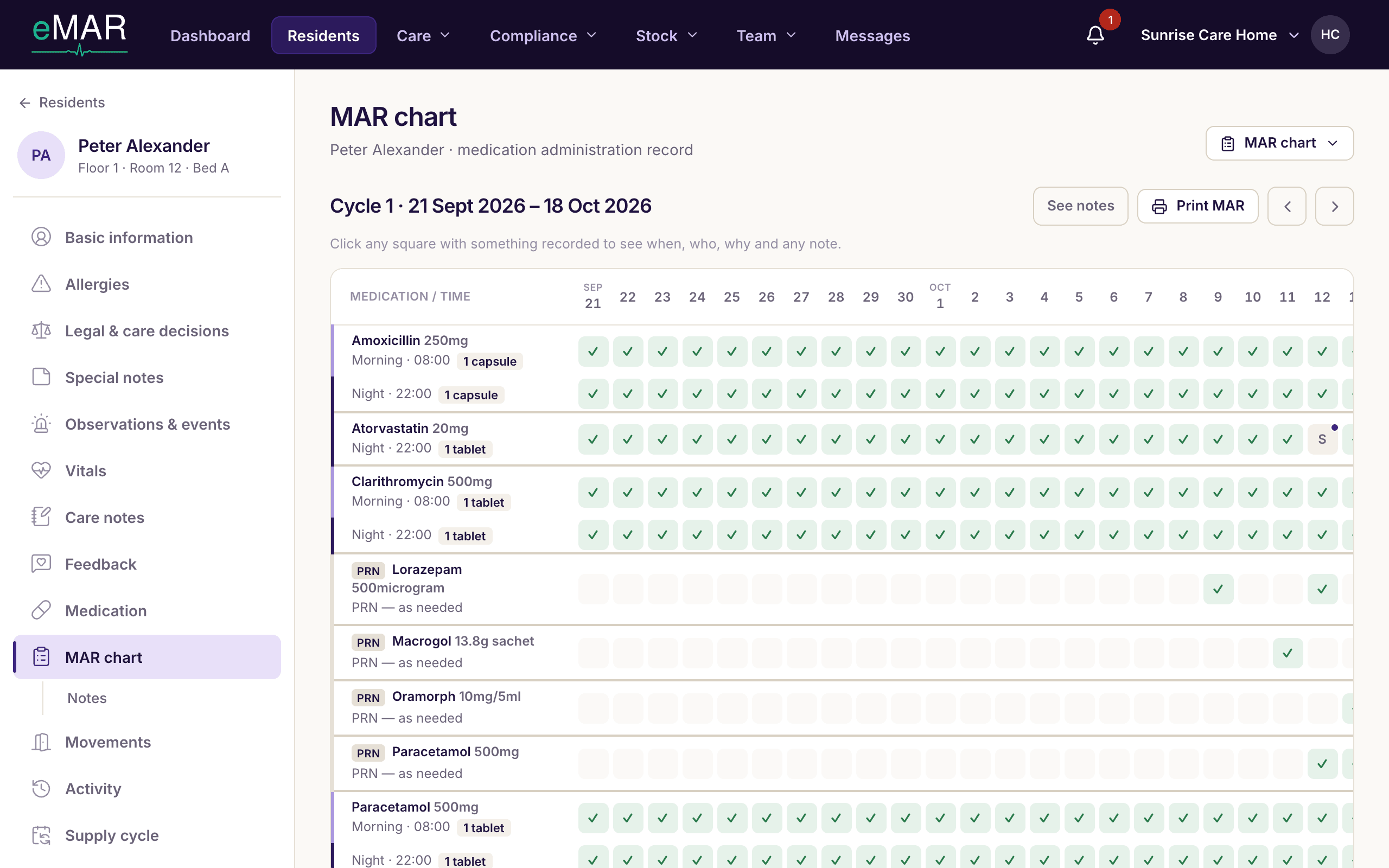
The auditor works through procedures, MAR charts, storage, the CD register and related records with your team, using samples such as three to five residents' MAR charts.
The report
Each check is scored Yes (evidence seen), No, or Not applicable, with every finding, why it matters, and the good practice we saw.
The action plan
An owner, a priority, a target date and the checklist reference for every action, signed by the auditor with a line for your manager to countersign.
Follow-up at 12 months
A second visit reviews progress against the plan: what has been done, and what is still open.
A sample report
A score for every area, and what to do next
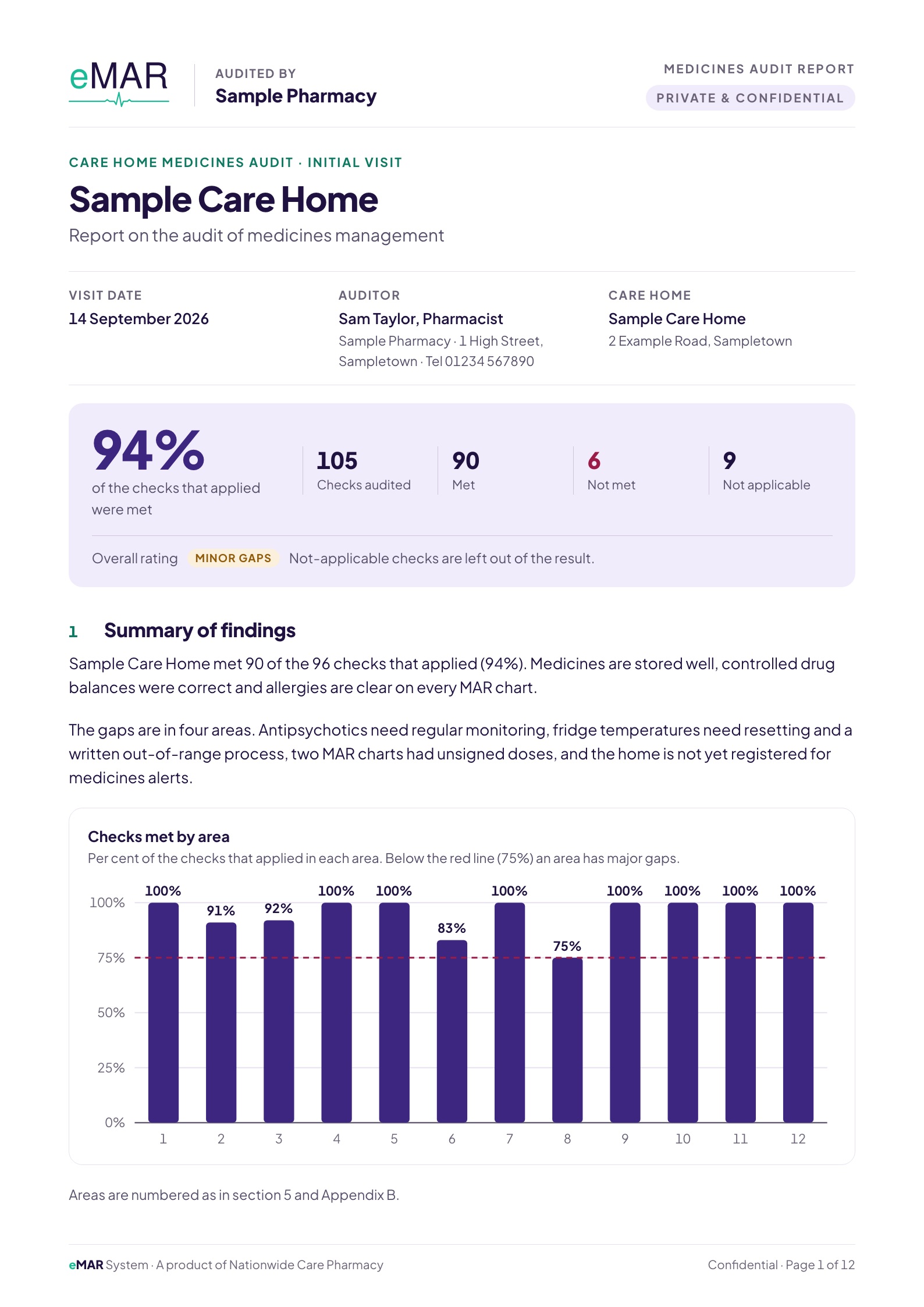
Result = checks met ÷ checks that applied. Checks that don't apply to your home are left out, not counted against you.
90 of the 96 checks that applied were met. 9 of the 105 did not apply.
Each of the 12 areas gets its own rating, and so does the audit as a whole. An audit helps you prepare for an inspection and evidence what you do; it cannot promise a rating.
The report
A summary for the manager, the detail for whoever fixes each gap
Every check as scored, for anyone who wants to see the working. It is an eMAR document with the auditing pharmacy named on every page, ready for the inspection folder.
- Executive summaryThe headline score and the priority actions.
- Results by areaAll 12, each with its score and rating.
- Findings requiring actionEach one with why it matters.
- Good practice observedWhat the home already does well, in writing.
- Action planAn owner, a priority (high, medium or low), a target date and the checklist reference.
- Sign-off and appendicesSigned and dated by the auditor; scope and method, and all 105 checks with the auditor's notes.
On eMAR, the moment an audit is signed off it appears on your care home's dashboard under Audits, with the date, who completed it, the score and the report to download. Nobody has to scan it in.
Is the audit different if we use eMAR?
No. The checks, the visit and the report are the same either way. With eMAR, the report and action plan also appear on your dashboard under Audits, alongside every audit before it.
Which standards do you audit against?
CQC Regulations 9 (person-centred care), 12 (safe care and treatment) and 14 (meeting nutritional and hydration needs) of the Health and Social Care Act 2008 (Regulated Activities) Regulations 2014, and the six statements of NICE quality standard QS85, medicines management in care homes. Findings are also framed against CQC's five key questions: safe, effective, caring, responsive and well-led.
What happens on the day?
The auditor works through your procedures, MAR charts, storage areas, the controlled drugs register and related records on site, with your staff. Some checks use a sample, such as the MAR charts of three to five residents. Each check is scored Yes (evidence seen), No, or Not applicable.
How is the score worked out?
Checks met, divided by the checks that applied. Checks that do not apply to your home are left out. Each of the 12 areas is then rated Met (100%), Minor gaps (75 to 99%) or Major gaps (below 75%).
What happens if we do not meet a check?
It becomes a finding in the report, with why it matters, and an action in the plan with an owner, a priority, a target date and the checklist reference. The follow-up visit 12 months later reviews progress against that plan.
Who sees the report?
Your care home and the auditing pharmacy. The report is marked confidential, and whether you show it to an inspector is up to you.
How often should we have an audit?
An initial visit, then a follow-up 12 months later to review progress against the action plan. If you would like audits more often than that, ask us.
Book a care home audit
Tell us about your home
Your home's name, how many residents you have and the dates that suit, and we'll be in touch to agree a day for the visit.
- 105 checks in 12 areas, on site
- A scored report and an action plan
- On eMAR or notThe audit is the same either way.
Thanks — we've got it.
We'll be in touch to agree a day for the visit.
One more step: your email app should have opened with your request written out. Press send and we'll be in touch.
Nothing opened? Copy the details below and send them to hello@emarsystem.com.